Health, Travel & Decision Intelligence
Medical Tourism Is Growing — Trust Must Grow With It
Why more men are exploring medical care abroad — and why clarity, accountability, and trust have to come before transactions.
Medical tourism is no longer a niche conversation.
Each year, more patients are traveling abroad for procedures ranging from dental and cosmetic care to orthopedic surgery, fertility treatment, and chronic condition management. Providers and facilitators are actively looking to attract patients from high-outbound regions like Florida and Central America, where access, cost, wait times, and insurance gaps often push people to look elsewhere.
At the same time, one trend is becoming increasingly clear: men are participating more in medical tourism than ever before — often quietly, independently, and with very different decision-making dynamics than traditional wellness or leisure travel.
This growth brings opportunity.
It also brings responsibility.
At The Modern Green, we believe medical tourism cannot be approached like leisure travel, influencer marketing, or lead generation. The stakes are higher. The consequences are real. And trust must come before transactions.
Why Medical Tourism Demands a Different Model
Most tourism platforms are built like funnels: attention → interest → booking → conversion.
That model breaks down in medical tourism.
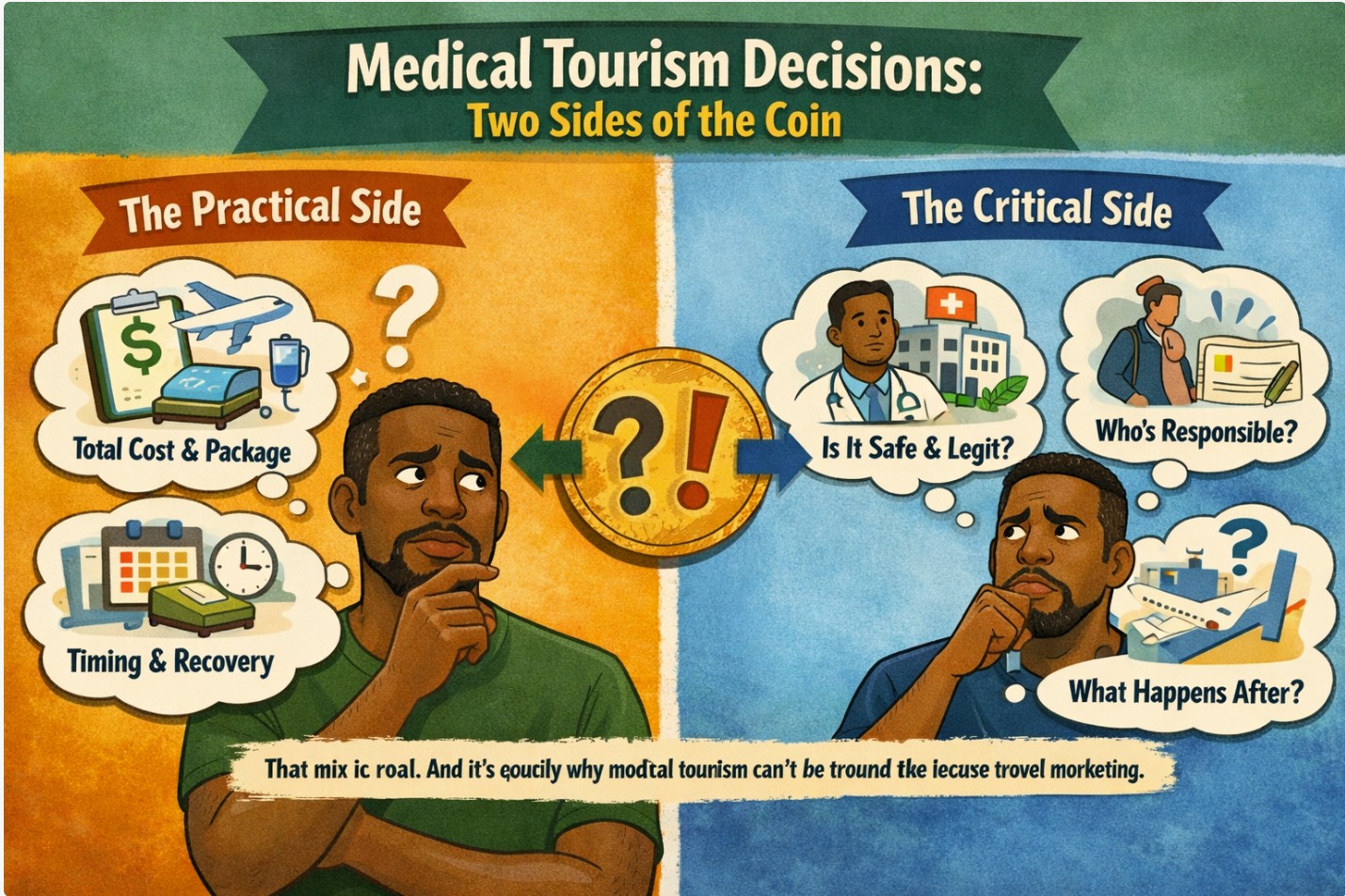
When health decisions are involved, people are asking two kinds of questions at once.
On one side, it’s practical:
- What’s the total cost — procedure, travel, stay, and follow-up?
- What does the package actually include?
- How fast can I get it done, and what’s the recovery plan?
On the other side, it’s deeper — and higher stakes:
- Is this safe and clinically sound?
- Who is accountable if something goes wrong?
- Am I being pressured into a decision I don’t fully understand?
That mix is real. And it’s exactly why medical tourism can’t be treated like leisure travel marketing.
Thinking in a Matrix, Not a Funnel
The Modern Green approaches tourism as a matrix, not a funnel.
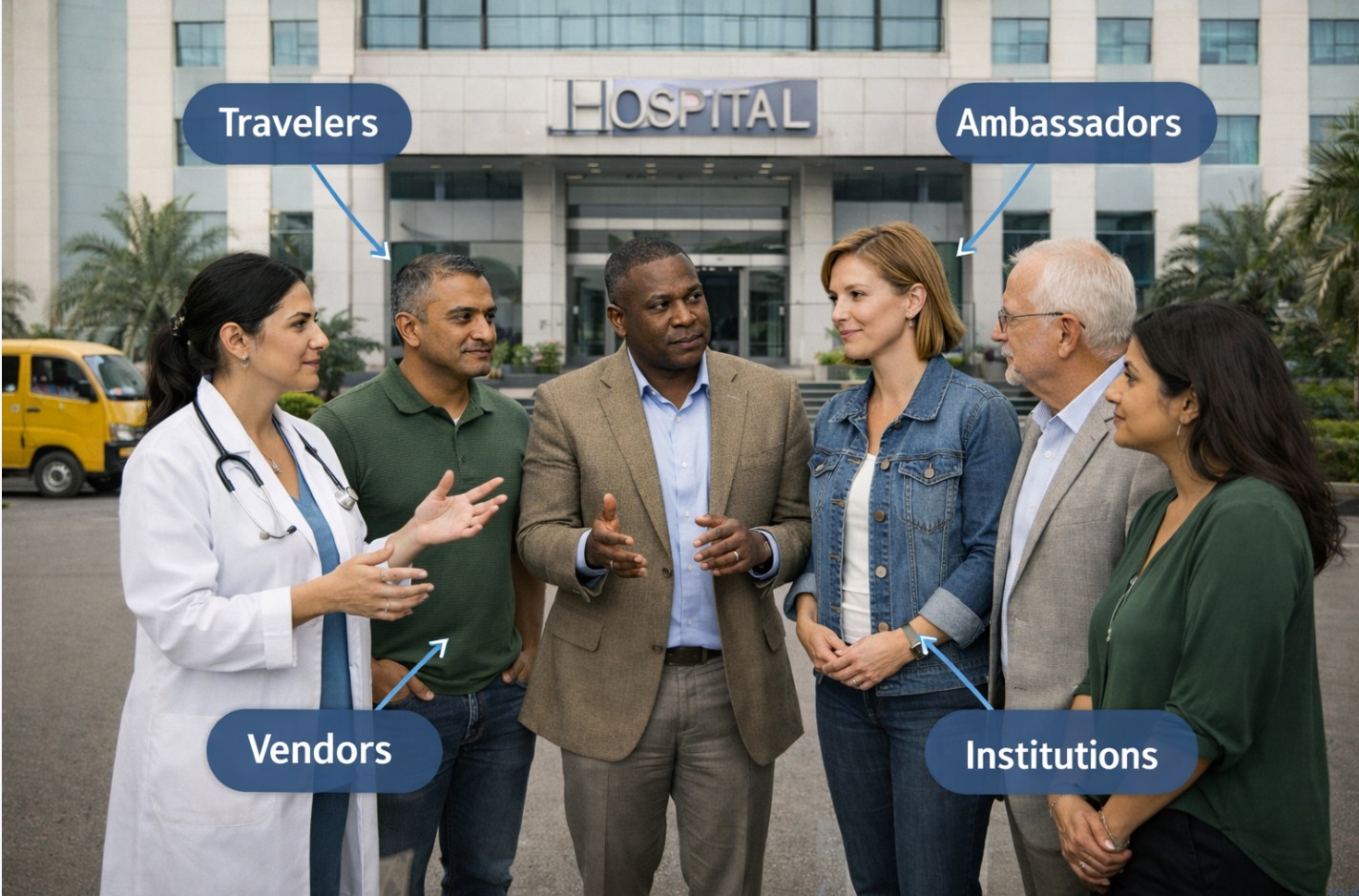
Vertical axis: Stakeholders
Travelers · Vendors · Ambassadors · Institutions
Horizontal axis: Tourism Segments
Diaspora · Medical · Wellness · Heritage · Events
Every intersection creates a different trust question.
Medical tourism sits at the highest-stakes intersection — which is why our approach begins with discovery only.
What Each Stakeholder Gains in a Trust-First Medical Tourism Model
Travelers / Patients
Role: Information-seeking, not booking
Many people considering medical travel are doing so quietly. Men in particular often research alone, avoid sales conversations, and delay asking questions until late in the process.
What they need is not persuasion — it’s clarity.
Phase 1 Value
- Reduced decision anxiety
- Language for questions they don’t know how to ask
- Context that sales representatives can’t or won’t provide
Phase 1 Outputs
- What I needed to know before considering treatment abroad
- Decision-readiness checklists
- Red-flag awareness (not recommendations)
- Ethical and safety considerations explained plainly
Vendors / Providers
Role: Transparency signalers, not closers
Hospitals, clinics, and facilitators increasingly want access to international patients — but credibility cannot be built through aggressive marketing alone.
Phase 1 Value
- Visibility without commoditization
- Alignment with informed, serious audiences
- Trust signals that outlast ad spend
Phase 1 Outputs
- Structured informational profiles
- Accreditation and credential visibility
- Clear explanation of the patient journey
- Explicit openness to verification
Ambassadors & Travelers-in-Community
Role: Context translators
Phase 1 Value
- A safe way to share insight without liability
- Recognition as contributors, not endorsers
- Protection from being mistaken as medical advisors
Institutions & Community Stakeholders
Role: Legitimacy anchors
Phase 1 Value
- Observational insight into patient concerns
- Risk-aware participation
- Educational visibility without promotion
The Bigger Picture
Medical tourism will continue to grow. Men will continue to participate more. Providers will continue to look outward for patients.
The question is not whether this market expands — it’s whether it expands responsibly.
The Modern Green is building decision infrastructure, not sales pipelines.
Because when health is involved, trust isn’t a feature.
It’s the foundation.
Author: David
Founder of The Modern Green connecting travelers with trusted local experiences worldwide. “We gon’ take you all around the world.