

The Modern Green

Category: Uncategorized

Uncategorized

A Delay That Became a Destination

I did not plan to go to Portugal.It was not on my vision board, my travel list, or even in my imagination. As a Black woman with a clear understanding of history—and Portugal’s role at the start of the transatlantic slave trade—it was not a place I ever aspired to land. At the time, I was a 45-year-old Realtor, still moving fast, still navigating life as a retired veteran with my laptop never far from reach. Portugal entered my life not through intention, but through delay. The first time Portugal showed up, I was sitting on an overbooked plane after visiting my dad. We had attended homecoming at his alma mater, South Carolina State University. I sat in my seat with my laptop open, working like any other day. The flight was full—overbooked, actually. When the airline began offering vouchers for anyone willing to give up their seat, I hesitated. My ears always perk up in moments like that because I want to see how much time I truly have. Usually, I’m open to the offer. Then the amount increased.I raised my hand. I didn’t know it then, but that decision—made casually and practically—would reroute my life. Portugal was not a destination I chose. It was a destination that chose me—through timing, chance, and a decision I made without overthinking. I had three months to use an airline voucher I never planned on having. I already had a solo trip booked to Mexico City a couple of months later—my first. I had done extensive research for that trip because, outside of resorts, solo travel felt intimidating to me at first. When I returned home, I pulled up a world map, closed my eyes, and let my cursor land. It landed on Portugal. Even after serving over twenty years in the military, I had never set foot in Europe—never even smelled the air. By the time I arrived in Mexico City in December 2024, Portugal was already booked—waiting for me on the other side of that trip. Eight days in CDMX, a brief return to San Antonio to wash clothes and update my suitcase, and then I boarded another flight—this time across the Atlantic Ocean. I didn’t know it yet, but something had shifted. I knew that if I was going to do this, I couldn’t rush it. This trip wasn’t about checking a country off a list. Being alone in Mexico City showed me that I could live a life like this—one filled with intentional travel and lived experiences. It was something I probably should have noticed much earlier, maybe during the height of COVID, when I first retired. This wasn’t about escape.It was about using time as a foundation. Time to observe.Time to feel.Time to understand why I wanted to travel in the first place. Before Portugal, I had already traveled extensively. I lived in Japan for over eight years and visited the Caribbean many times—Sint Maarten, the Bahamas, the Dominican Republic, Costa Rica, Jamaica, etc. I had also been on several cruises. I understood what it meant to get away. But over time, I began to feel disconnected from the version of travel I kept seeing repeated. So much of it revolved around resorts, unlimited drinking, and nonstop partying. Beaches, cocktails, and very little sleep. At some point, I realized I was over that life. I wasn’t interested in excessive drinking or packaged experiences anymore. I wanted to see the world differently—to understand places, not just consume them. What unsettled me most was what existed beneath those resort experiences. In many deeply colonized countries, the resort often felt like a modern plantation. The structure was familiar: local people working endlessly, serving comfort and luxury, while profits flowed elsewhere. As a Black woman who understands history, I couldn’t ignore how normalized that dynamic still is. I didn’t want to keep traveling in ways that padded the pockets of colonizers while reducing entire cultures to backdrops and service roles. That version of travel no longer aligned with who I was becoming. I wasn’t looking for another vacation.I was looking for a place where I could land. That realization wasn’t rooted in judgment, nor in a belief that I was above anyone or any place. The people who work in those environments work hard—often doing what they must to support their families within the systems that exist. I don’t take that lightly. My shift wasn’t about “giving back” or positioning myself as someone who needed to rescue a country. It was about honesty. About how I wanted to move through the world. I wanted to experience places as lived-in communities, not curated escapes. I wanted to participate in daily life—not just consume it. So when I say I was looking for a place where I could land, I mean a place where I could exist without excess, without performance, and without feeling complicit in dynamics that no longer aligned with my values. That was the mindset I carried with me when I left on Christmas Eve. I landed in Portugal on Christmas Day—December 25, 2024. I stayed at the Locke de Santa Joana hotel simply because it was centrally located. It was comfortable, practical, and grounding—exactly what I needed. Amenities like a washer and dryer were included, which allowed life to feel normal, not temporary. I went out every single day. I walked the city. I ate at local restaurants. I observed how people lived. Lisbon felt layered and multicultural. I saw African and Afro-descendant presence. I heard multiple languages. It didn’t feel one-note or closed off—it felt lived in. During that time, I met other solo travelers and people considering the expat life. We connected organically—sharing space, time, and conversation without pressure. It felt easy. I also took a tour that explored how the transatlantic slave trade began there. It was intense, eye-opening, and something I would take again without hesitation. Time in Lisbon felt natural. Like community without force. After New Year’s, I took the train north to
Read More »
Uncategorized

How AI & Mobile Technology Increase Safety and Traveler Confidence in Emerging Tourism Destinations

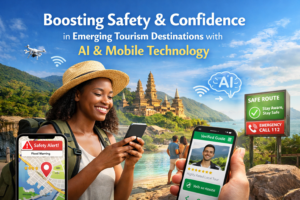
How AI & Mobile Technology Increase Safety and Traveler Confidence in Emerging Tourism Destinations How Emerging Tourism Destinations Can Use AI & Mobile Technology to Increase Safety and Traveler Confidence By The Modern Green Safety and traveler confidence are now the foundation of tourism growth. For emerging tourism destinations, attracting visitors is no longer about promotion alone—it’s about trust, preparedness, and real-time access to reliable information. Tourism research consistently shows that perceived safety is one of the strongest predictors of destination choice, particularly for first-time visitors (Fuchs & Reichel, 2011). AI and mobile technology now give destinations practical tools to reduce uncertainty, strengthen safety systems, and build traveler confidence before arrival. How The Modern Green Supports This The Modern Green is designed as a trust-first travel platform that supports emerging destinations by combining technology with community validation. Verified Vendors: Trusted local service providers featured through community referrals and traveler validation. Explore Vendors Curated Events: Cultural festivals, concerts, and experiences that help travelers plan safely and intentionally. Explore Events Safety & Travel Resources: Centralized guidance, emergency references, and destination insights designed to reduce uncertainty. Explore Safety Resources Confidence is built when travelers and destinations meet in the middle—through transparency, trust, and shared responsibility. The Trust Gap Facing Emerging Tourism Destinations Emerging and developing tourism destinations often face structural trust challenges: Limited global visibility Fragmented safety information Informal local vendor ecosystems Language and cultural barriers Reliance on unverified word-of-mouth AI and mobile technology help bridge this trust gap by making safety, context, and credibility visible to travelers. How AI Improves Actual Safety in Tourism Real-Time Risk Awareness AI-powered safety systems allow destinations to identify, communicate, and respond to risks more effectively. These tools include: Real-time emergency alerts Geo-based safety notifications Crisis and disruption monitoring Multilingual emergency guidance Smart tourism research confirms that timely access to relevant information reduces stress and increases traveler confidence, particularly in unfamiliar destinations (Gretzel et al., 2015). Mobile Technology as a Traveler Confidence Layer Mobile platforms are now central to how travelers navigate destinations. Studies show that smartphones function as safety, navigation, and decision-support tools throughout the travel journey (Dickinson et al., 2014). Effective tourism mobile platforms provide: Centralized safety and emergency information Local emergency contacts Cultural norms and expectations Pricing transparency Navigation and language support When travelers know where to turn for reliable information, confidence follows. AI, Trust, and Travel Decision-Making Beyond logistics, AI influences traveler psychology. Research shows that technology-mediated travel tools shape: Destination perception Preparedness and confidence Willingness to travel Likelihood to recommend or return AI-supported systems help travelers feel informed and empowered, increasing trust in emerging destinations (Tussyadiah et al., 2018). Verified Local Vendors Build Destination Credibility For emerging destinations, trust is often built at the local level. AI-assisted verification and community validation help: Surface trustworthy local vendors Detect patterns of risk or complaints Strengthen review authenticity Protect travelers without excluding small businesses Research shows travelers trust community-validated information more than anonymous rankings or paid placements (Filieri et al., 2015). This is why vendor credibility is a core pillar of sustainable tourism growth. Digital Identity and Secure Travel Infrastructure Digital identity frameworks and mobile verification tools further enhance safety by reducing fraud and improving accountability. The World Economic Forum highlights digital identity as a key enabler of secure, trusted travel—particularly across borders and in developing tourism markets (WEF, 2019). Why Perceived Safety Drives Tourism Growth Perceived safety directly influences: Destination choice Length of stay Spending behavior Repeat visitation Reducing uncertainty through AI and mobile access strengthens both perceived and actual safety outcomes (Fuchs & Reichel, 2011). Responsible AI and Ethical Tourism Development Trust must be protected. Industry guidance emphasizes that responsible AI adoption requires: Transparency in data use Privacy protections Community involvement Clear accountability Ethical, trust-first AI systems create long-term tourism resilience (WTTC, 2023). What This Means for Emerging Tourism Destinations Invest in mobile-first safety infrastructure Use AI to support coordination, not surveillance Build trust through verification and transparency Partner with platforms that value community validation Tourism confidence is built through preparation, trust, and shared responsibility—not marketing alone. Sources & Further Reading Gretzel et al. (2015). Smart Tourism: Foundations and Developments. Dickinson et al. (2014). Tourism and the Smartphone App. Fuchs & Reichel (2011). Destination Risk Perceptions. Filieri et al. (2015). Trust in Consumer-Generated Media. Tussyadiah et al. (2018). Technology and Attitude Change in Tourism. UN World Tourism Organization (2021). Artificial Intelligence and Tourism. World Economic Forum (2019). Known Traveller Digital Identity. World Travel & Tourism Council (2023). Responsible AI in Travel & Tourism.

Read More »