
Why Trust Networks Matter More Than Police Presence Abroad
Rethinking what “safety” really means internationally—through community connection, local guides, and diaspora-informed cultural context.
Introduction: Rethinking What “Safety” Really Means Abroad
When many Americans travel internationally, safety is often imagined through a familiar lens: police patrols, armed checkpoints, and visible authority. The assumption is simple—where police presence is strong, travelers are protected.
But seasoned travelers, expatriates, and security professionals know this belief is often misleading. Across much of the world, police presence is reactive, limited, or symbolic, while real day-to-day safety is maintained through trust networks—the informal, relationship-based systems that quietly prevent harm before it happens.
For Black travelers in particular, these trust networks are not optional—they are essential. At The Modern Green, we believe safety abroad starts with community connection, not just official infrastructure.
👉 Explore how trust-based travel works: themoderngreen.com
Why Police Presence Abroad Is Often Overestimated
Official travel guidance quietly supports this reality. The U.S. State Department’s Overseas Security Advisory Council (OSAC) emphasizes situational awareness, local knowledge, and personal responsibility over reliance on immediate police intervention (OSAC). Similarly, the UK Foreign Office encourages travelers to seek local advice and understand cultural context rather than assume police will provide rapid or personalized protection (UK FCDO).
- Language and cultural barriers
- Limited jurisdiction over tourists
- Delayed response times
- Bureaucratic or political constraints
- Inconsistent enforcement standards
Police typically document incidents after harm occurs. Trust networks reduce the likelihood that harm occurs at all.
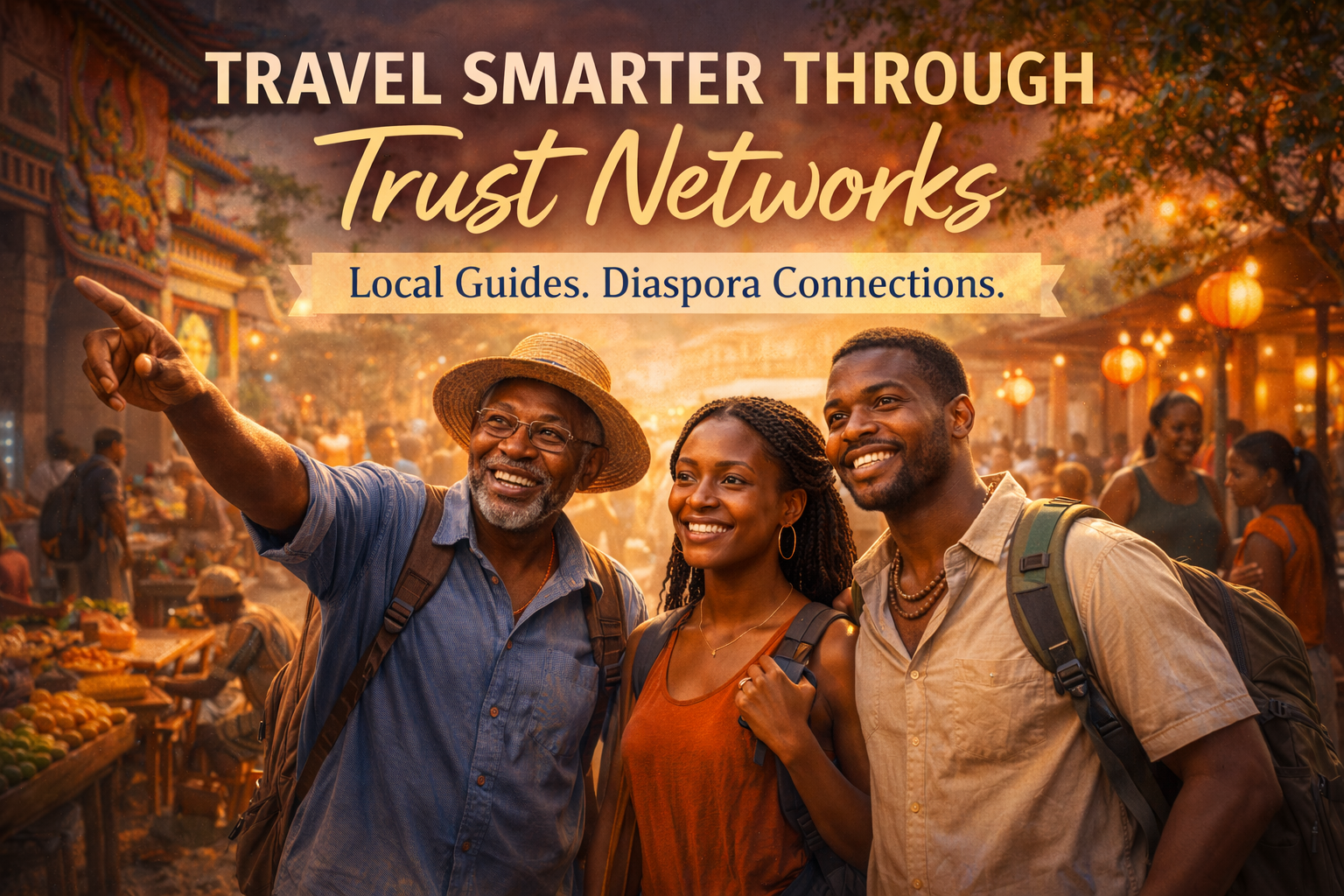
What Are Trust Networks? (And Why They’re So Effective)
Trust networks are informal systems of safety and accountability built through relationships rather than institutions. They include barbers and salon owners, taxi drivers and local guides, hotel staff and hosts, restaurant owners, community elders, and diaspora connections.
Sociologists refer to this as social capital—the networks that enable communities to function effectively and protect their members (World Bank – Social Capital).
- Lower crime rates
- Faster conflict resolution
- Greater informal monitoring
- Higher levels of mutual aid
In simple terms: people protect what they recognize.
The Diaspora Travel Reality Most Guides Don’t Talk About
Black travelers often navigate safety abroad using instincts shaped by lived experience. Across Africa, the Caribbean, Central America, and Latin America, familiar patterns emerge: a barber warns you away from a risky nightlife area; a taxi driver refuses to drop you in an unsafe neighborhood; a restaurant owner calls ahead to confirm a venue; hotel staff discreetly look out for you after hours.
These moments rarely appear in guidebooks, yet they are how many travelers stay safe. Anthropologist Edward T. Hall described many of these societies as high-context cultures, where meaning, safety, and trust are communicated through relationships rather than formal rules (High-Context Cultures).
This is why diaspora knowledge matters—and why culturally informed travel platforms are necessary.
A Security Professional’s Perspective: Why Trust Networks Work
From a security standpoint, trust networks are not informal alternatives—they are foundational layers of effective safety systems. In military and diplomatic operations, understanding the human terrain is as critical as understanding physical security infrastructure. Informal intelligence, local relationships, and community awareness consistently outperform surveillance alone.
- Neighborhood watch programs
- Community guardianship
- Informal intelligence sharing among business owners
As a security professional and veteran, I’ve seen repeatedly that the most effective safety systems are predictive, not reactive. Trust networks detect risk early—before uniforms are ever needed.
Why Trust Networks Matter Especially for Black Travelers
Black travelers often face added layers of visibility, assumption, and misinterpretation abroad. Trust networks help humanize travelers within local communities, reduce isolation and targeting, provide social legitimacy and protection, and improve overall travel experience—not just safety.
This is not about fear. It’s about moving with awareness. Platforms like The Modern Green exist to help travelers move smarter, not smaller.
How The Modern Green Turns Trust Networks Into Travel Intelligence
The challenge is that trust networks are often fragmented—passed quietly through word-of-mouth or private group chats. The Modern Green organizes this knowledge by highlighting community-verified vendors, featuring trusted local hosts and connectors, centering diaspora experience and cultural context, and encouraging traveler-to-traveler validation.
We are not replacing government advisories or law enforcement. We are complementing them with real-world insight.
👉 Explore trusted destinations, vendors, and travel intelligence: themoderngreen.com/explore
Redefining Safety Abroad
Police presence may deter certain crimes, but it does not guarantee personal safety—especially for travelers navigating unfamiliar cultural landscapes. Trust networks are ancient, effective, and human. They operate quietly, relationally, and with a depth of understanding no patrol schedule can replicate.
The safest place abroad isn’t where the police are most visible. It’s where people know who you are—and care that you’re there.

Author: David
Founder of The Modern Green connecting travelers with trusted local experiences worldwide. “We gon’ take you all around the world.