
The Modern Green • Culture & Connection
How traveling modern and staying rooted can help us understand one another across the Black diaspora.
By David Sims
President of The Modern Green
I want us to come home from our travels knowing a little more about one another.
We might choose a destination for the food, the music, a festival, or a few days to relax. Somewhere in that trip, there may be a conversation that stays with us. Someone explains a family tradition. A guide gives a street name a history. A dish we thought we recognized comes with a story we haven’t heard before.
That’s the kind of discovery I want The Modern Green to encourage. For me, traveling modern and staying rooted means enjoying what a place has to offer while taking an interest in the people and history that give it meaning. It also means carrying an understanding of where we come from, while staying open to what someone else can teach us.
The conversation around Da’Vinchi’s comments brings that idea into focus. During a discussion about non-American actors receiving American roles, he questioned American work ethic. The Joy Reid Show took up the remarks in its Uniting the Diaspora series, challenging the implication that Black Americans are lazy. 1, 2
I reject that stereotype. People deserve more care than a sweeping judgment about an entire community. In a related One54 conversation, Eddie Glaude Jr. argued that distancing ourselves from Black Americans through claims of superior work ethic helps sustain a racial hierarchy. 3
It makes me wonder how much of what we think we know about one another comes from a relationship, and how much comes from something we’ve heard repeated. Travel gives us an opportunity to reconsider those assumptions through the people we meet and the places we explore. We have to be willing to listen once we get there.
We have a lot to talk about
When I think about the connection across the diaspora, W. E. B. Du Bois comes to mind. At the 1900 Pan-African Conference in London, he joined Black leaders from Africa, the Caribbean, and the United States and wrote the gathering’s address, To the Nations of the World. They were bringing concerns about racism into an international conversation. 4
What interests me is that people living in different places could recognize something of their own conditions in one another’s stories. That gives us a place to begin today. We can ask about the opportunities a family had, the barriers it faced, the traditions it held onto, and the community it built around itself.
Those questions can reveal connections. They can also help us understand why another person sees the world differently. Both discoveries matter.
Our histories have parallels, but the details belong to particular places and people. Someone else’s experience of race, nationality, or belonging may sound familiar without matching our own. Even people raised in the same country can carry very different stories about it.
I can be proud of where I come from and still have plenty to learn. I can recognize a connection to someone without assuming I already understand their life. That is part of staying rooted, too: knowing my own story well enough to share it, and giving yours the same attention.
“I can be proud of where I come from and still have plenty to learn.”
Let a place tell you more
Imagine planning a trip because a piece of music caught your attention. You find out where it comes from, learn about the musicians, and discover a community you knew little about. By the time you arrive, you have something you want to understand. You also have people whose work you want to hear and support.
Garifuna culture offers one example of how much there is to discover. UNESCO describes the Garifuna language as part of the Arawakan family, and its music as bringing together African and Indigenous American elements. Songs also carry history and traditional knowledge. A visitor looking only for an African connection would be missing part of that story. 5
Something can feel familiar and still have a history we know very little about. Learning that history gives us more to appreciate, and a reason to listen to the people who carry it forward.
The same curiosity can shape an afternoon in a neighborhood, a visit to a museum, or a meal. When there is an invitation to talk, we can ask how a dish became part of someone’s family life, what a celebration means locally, or what people wish visitors understood about their home.
We should also be interested in what people are doing now. Who is making music? What are young artists creating? Which businesses are people excited about? A place deserves to be encountered in the present, with people free to describe their own lives and ambitions.
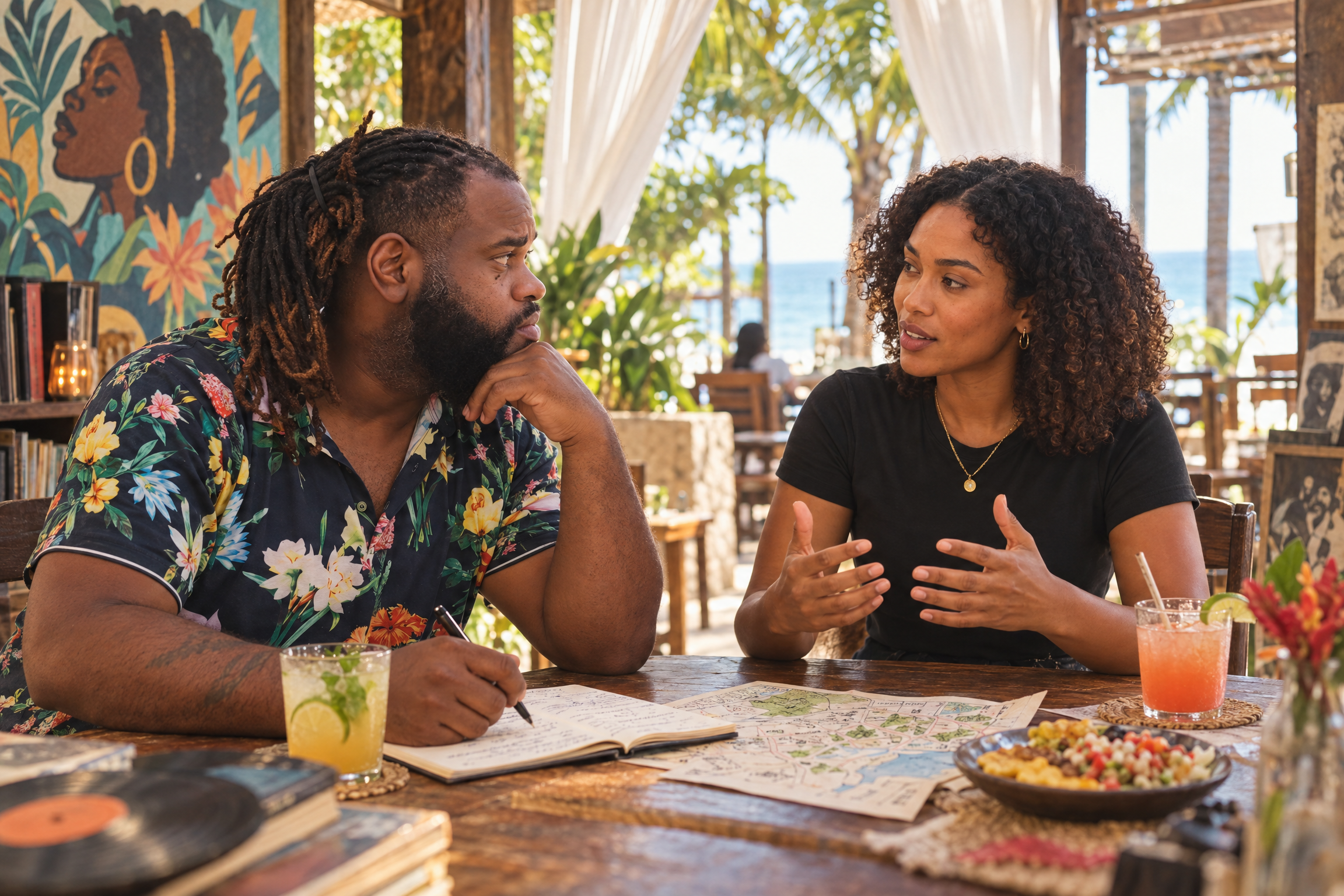
And a conversation can go both ways. We bring stories with us, too. Sharing why something reminds us of home may open a connection. Listening to why it means something different to our host can deepen it. We can leave that conversation feeling closer and knowing more about our differences.
Make room for joy
I want this kind of travel to feel inviting. There should be room to dance, eat well, laugh, rest, and enjoy being somewhere new. Pleasure belongs in our understanding of Black life.
Anthropologist Bianca C. Williams takes that seriously in The Pursuit of Happiness. Her research follows a particular group of African American women traveling to Jamaica and building relationships there and online. She explores their search for happiness and belonging, along with the differences in money, citizenship, and opportunity that complicate those connections. 6
Her work helps me think about travel as a place for both joy and discovery. A holiday can give someone breathing room. It can bring friendship, a sense of recognition, or a new interest that lasts long after the trip. Those experiences deserve a place alongside conversations about history.
I also think connection deserves time. Shared African ancestry doesn’t mean every encounter will feel like a reunion. We may misunderstand each other. We may disagree. A little patience, and the willingness to ask another question, can give a relationship room to develop.
Travel creates the opportunity. The understanding comes through the attention we give to people and what they choose to share.
What I want The Modern Green to help us discover
As president of The Modern Green, I want our travel discovery platform to help people make those connections before, during, and after a journey.
A story should give you a reason to care about a place. It might introduce a local historian, a cook, an artist, or a business owner whose work makes you curious. From there, you might decide to visit, explore more of their work, or support a business you would otherwise never have found.
That is how I see cultural storytelling leading naturally to travel. You discover something that matters to you, learn more about it, and decide you want to experience the place for yourself.
I want local people to help shape those stories. Scholars can give us historical context. Residents can tell us what that history means in their lives today. The people sharing their knowledge and creating the experiences visitors enjoy should receive credit and fair compensation for their work.
Traveling modern also means being curious about how culture is changing. We can appreciate an inherited tradition and be interested in what a younger generation does with it. Staying rooted leaves room for people to grow, create, and decide what they want to carry forward.
This discovery can begin close to home. A neighborhood across town, a cultural event, or a community museum may introduce us to a story we have been passing by. Understanding can grow from those encounters, too.
Da’Vinchi’s comments have given us a reason to talk about the assumptions we carry. The conversation can continue through the places we discover and the people we get to know.
My invitation is simple: choose a place you’re curious about. Enjoy it. Learn something about the people who call it home, and give them room to tell you what matters to them. Bring your own story into the conversation.
That is what I mean by traveling modern and staying rooted. We carry our histories with us and give ourselves the chance to understand someone else’s.
Travel modern. Stay rooted.

Author: The Modern Green Team
I’m a luxury-on-a-budget guy who loves beach escapes, local food, vibrant nightlife, and genuine connections. Belize is a favorite, but I’m always ready to explore.