
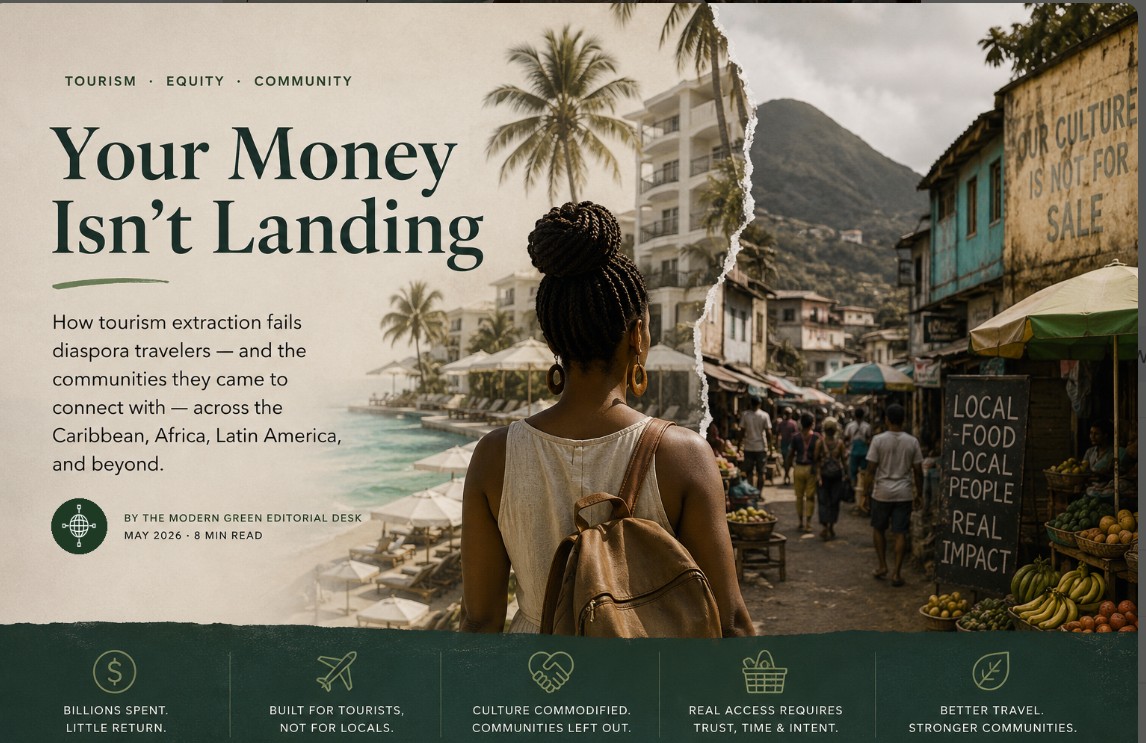
You booked the flight. You did the research. You got there. And then, somewhere between the resort shuttle and the tourist-strip restaurant serving chicken tenders with a coconut garnish, you realized: the version of this place you came for is nowhere near where you’re standing.
This is the quiet failure at the heart of diaspora tourism. The money moves — billions of it annually, flowing from Black and Afro-diaspora travelers across North America, Europe, and beyond into destinations in the Caribbean, West Africa, Central America, and Latin America. But too often, that money doesn’t land where it was meant to. It flows offshore. It feeds enclaves. It funds the construction of a version of these places designed to look authentic while hollowing out what actually is.
A traveler who eats well, connects with local vendors, and leaves with stories to tell becomes a long-term ambassador for that destination. The ones who don’t? They don’t come back.
The Structure of Extraction
Built to extract, not to share
High-end tourism projects frequently bypass local communities entirely. Profits flow offshore. Guests are kept inside self-contained enclaves — resorts, curated packages, and all-inclusive setups engineered so that every dollar spent stays within the same ownership structure. Imported food, foreign management, and staff hired for aesthetics rather than cultural knowledge deepen the disconnection.
For diaspora travelers, the irony can be painful. You came to reconnect — with culture, with heritage, with a version of the world your family came from. And the economic infrastructure wrapped around your visit was built to extract from that culture, not to celebrate it.
This isn’t accidental. It’s the legacy of tourism models developed without Black and local communities at the table. Regulatory frameworks across the Caribbean, Sub-Saharan Africa, and Latin America often fail to protect community interests when foreign capital enters. Land rights remain contested. Cultural heritage — music, food, ritual, language — gets commodified without consent or compensation.
A Missing Audience
European Black travelers are invisible in this conversation
One of the most overlooked gaps in diaspora tourism is the near-complete absence of Afro-European travelers from the picture. Black travelers from the UK, France, the Netherlands, Germany, and Portugal carry deep ancestral and emotional ties to destinations in West Africa, the Caribbean, and Central America — but destinations like Belize, which sits at the intersection of Garifuna, Afro-Caribbean, and Creole culture, rarely see themselves marketed to or through this audience.
Travel infrastructure in these destinations was built to attract American and Canadian visitors. European diaspora travelers are expected to slot into that same framework, even when their connection to the place is older, deeper, and shaped by entirely different histories. The result is fewer culturally resonant experiences surfaced, fewer community vendors getting exposure to that market, and a traveler who leaves without the connection they came searching for.
The Food Problem
Authenticity lives two streets off the main strip
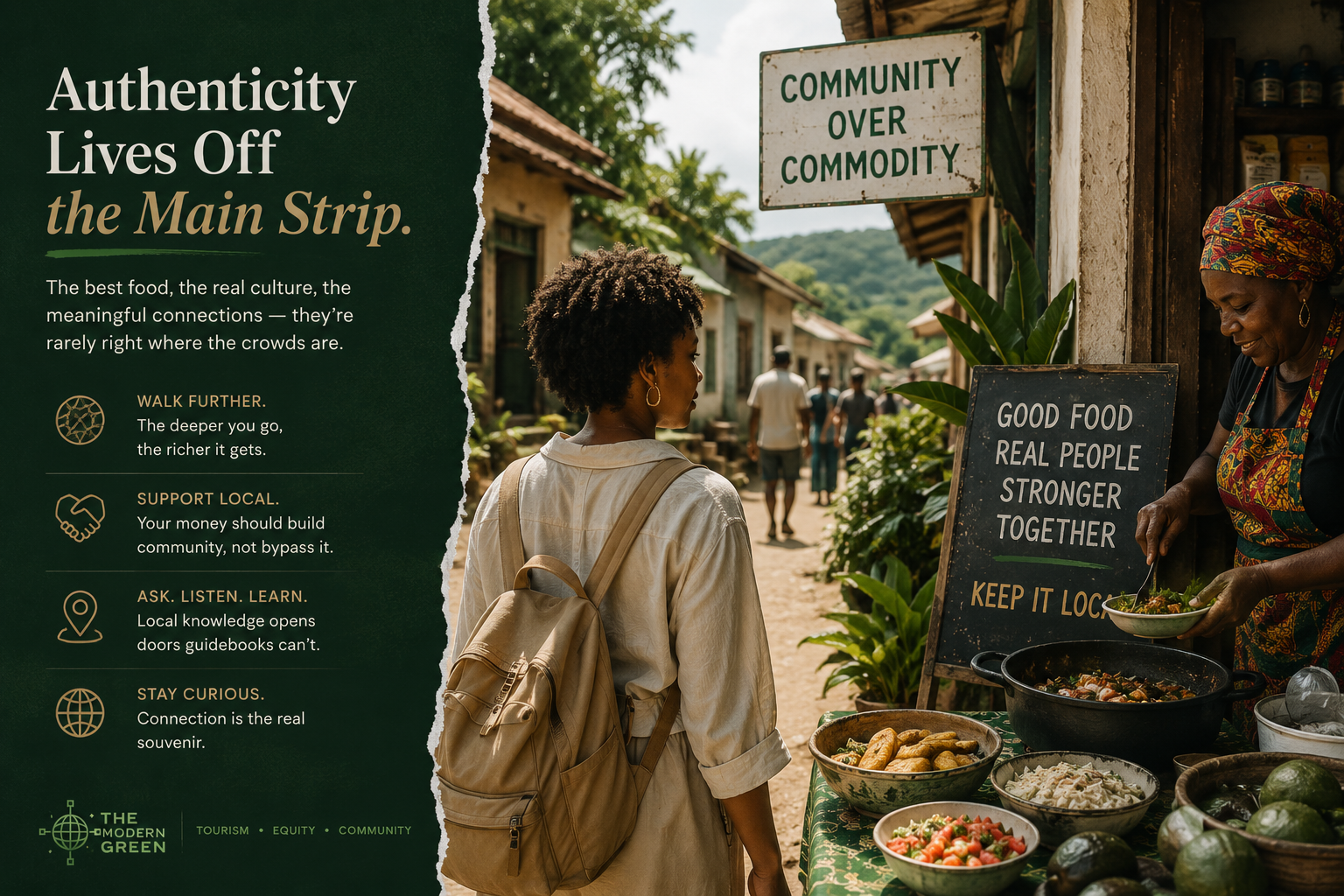
The restaurants closest to the hotspots tend to be the least interesting. They’ve made a calculated trade: flatten the menu to reach the widest possible audience, sacrifice culinary identity for volume, and survive on foot traffic rather than reputation. The result is a corridor of food that tells you nothing about where you are — chicken tenders, generic pasta, “local-inspired” dishes that have had all the risk, and all the soul, removed.
Meanwhile, a twenty-minute walk or a short local bus ride away, someone is cooking with herbs their grandmother grew, plating dishes that carry the actual flavor profile of that island or that coast — food with creative infusions that reflect real culinary lineage, not a tourism board’s idea of what’s approachable. That cook doesn’t have a review on the main apps. She doesn’t need one — until she does.
Getting into local communities takes more effort and more trust. It requires better information — the kind that comes from people who actually know the place, not from aggregated reviews written by visitors passing through.
Professionalism & Presentation
Aesthetics aren’t superficial — they’re a signal of respect
There’s a persistent myth that authenticity and professionalism are in tension — that the “real” local experience means roughing it, accepting lower standards, overlooking presentation. This is a false choice, and it’s one that has done real damage to local vendors trying to compete with polished, foreign-owned operations.
Aesthetics matter. The way a space is designed, how a dish is plated, how a business presents itself online — these are not surface concerns. They are signals of care, of investment, of how seriously a business takes its guests. Local vendors who combine genuine cultural knowledge with professional presentation and strong visual identity don’t just attract more travelers. They command the respect, and the price point, they deserve.
The gap isn’t in the quality of what local communities offer. It’s in the visibility and infrastructure built around them.
The Cost of Disconnection
If the connection fails, the traveler doesn’t come back
When diaspora travelers arrive somewhere and fail to make a real connection — when the food is forgettable, the experience feels staged, the community they came to engage with remains just out of reach — they don’t return. And they don’t send others.
This is the economic cost that rarely gets calculated. Repeat travel, word-of-mouth referrals within tight diaspora networks, the social influence of a traveler who feels genuinely seen and served — these are enormous drivers of sustainable tourism revenue. The destinations that figure out how to route diaspora travelers into genuine community connection will see compounding returns. The ones that don’t will keep cycling through first-timers who check the destination off and move on.
The most effective vote against extractive tourism is a well-placed dollar — spent local, spent intentionally, spent with someone who will still be there when you come back.
Fixing this at a structural level remains unresolved. But travelers can act now — by routing spending toward locally owned businesses, eating where residents eat, hiring guides who are from the community rather than assigned to it. Discovery has to start before the flight lands, not after it’s too late.
Tags: Diaspora travel · Local economy · Caribbean · West Africa · Belize · Latin America · Afro-Europe · Community tourism
Find vendors who actually know the place.
The Modern Green surfaces locally trusted services and experiences. Explore themoderngreen.com before you arrive — not after.
